Viewing a city from its waterways provides a perspective that land-based exploration fundamentally cannot replicate. In the French capital, the river acts as a living, flowing museum of structural history. The Seine effectively divides the metropolis into the Left and Right Banks while simultaneously acting as its central unifying artery. To genuinely understand the structural evolution of this historic destination, one must observe it from the exact vantage point that early master builders considered when designing their monumental commissions. The stone facades lining the riverbanks were explicitly constructed to project power, elegance, and cultural dominance to anyone navigating the waters. The banks of the Seine hold a prestigious designation as a UNESCO World Heritage site, a testament to the continuous line of architectural triumphs that frame the water. Securing a vantage point on a private vessel allows discerning visitors to absorb these intricate details thoroughly, free from the standard distractions of crowded tourism.
The story of structural design in the city begins firmly at the water’s edge. Urban planners across centuries recognized the river as a reflective canvas that could amplify the grandeur of their visions, mirroring stone and glass perfectly on calm days.
The Medieval Foundations: Notre-Dame and the Île de la Cité
Gothic architecture purposely sought to draw the human eye upward toward the heavens, and nowhere is this design philosophy more evident than at the Cathedral of Notre-Dame. When viewed from a vessel traversing the river, the cathedral reveals its complex skeletal support system in striking clarity. The flying buttresses, initially added as a strict functional necessity to prevent the high, thin walls from collapsing under their own weight, evolved into a defining aesthetic feature. From the river, astute observers can clearly identify the precise geometry of the massive stone arches reaching out to brace the choir. You readily notice the imposing gargoyles jutting out from the upper tiers. Builders designed these primarily as functional water spouts to protect the delicate stone walls from rain erosion, though they quickly became highly recognizable symbols of medieval myth. Navigating around the Île de la Cité offers an additional, uninterrupted view of the Conciergerie. Its pointed medieval turrets and massive twin towers hint darkly at its history as both a former royal palace and a formidable prison during the French Revolution.
The Renaissance Influence: The Louvre’s Transformation
Gliding further down the current, the structural timeline logically advances into the Renaissance era. The Louvre Palace presents a monumental, rigorously structured facade directly to the water. Initially constructed as a heavily fortified medieval stronghold to protect the local populace from river-borne invasions, it gradually evolved over the centuries into a sprawling, opulent royal residence. Viewing the exceptionally long, symmetrical southern facade from the water intensely highlights the classical French Renaissance style. The repetitive placement of large casement windows, ornate pilasters, and steeply pitched Mansard roofs demonstrates a clear historical shift. Builders moved away from defensive, closed-in architecture toward a confident display of vast wealth, security, and aesthetic refinement. The wide expanse of the river channel provides the necessary distance to appreciate the sheer, uninterrupted scale of the building in a single, comprehensive glance, a structural feat impossible to achieve from the narrow pedestrian streets directly behind it. Across the water sits the Musée d’Orsay, presenting a beautiful example of Beaux-Arts railway architecture with its massive glass clocks proudly facing the channel.
In exploring the unique perspective of Parisian architecture from the water, readers may find it insightful to delve into a related article that discusses the various architectural styles visible along the Seine River. This article not only highlights the historical significance of these structures but also emphasizes the importance of waterways in shaping the city’s urban landscape. For more information, you can visit this link.
Bridges as Monuments: Crossing the Seine in Style
Bridges in this urban center represent far more than functional pieces of infrastructure connecting two banks. They serve as monumental sculptures in their own right, each reflecting the advanced engineering capabilities and distinct artistic tastes of their respective historical eras.
Pont Neuf: The Oldest Bridge in Paris
Despite its name translating directly to “New Bridge,” Pont Neuf proudly holds the title of the oldest standing bridge across the Seine. King Henry IV ordered its rigorous construction in the late sixteenth century, introducing a revolutionary structural design to the capital. It was the absolute first stone bridge in the city built without commercial houses lining its edges, ensuring pedestrians could finally gaze directly at the flowing river below. When passing gently underneath its span, maritime travelers should carefully observe the 381 carved stone mascarons decorating the outer sides. These intricate carved faces represent various Roman deities, woodland satyrs, and humorous grotesques. Observing them from a privately chartered vessel provides a highly advantageous view of their distinct, uniquely chiseled expressions. The heavy, robust stone arches reflect the sturdy masonry engineering required to withstand centuries of relentless river currents and occasional winter ice flows.
Pont Alexandre III: The Pinnacle of Beaux-Arts Design
In stark, intentional contrast to the heavy masonry of Pont Neuf, Pont Alexandre III uniquely exemplifies the flamboyant Beaux-Arts style prevalent at the end of the nineteenth century. Constructed specifically for the 1900 Exposition Universelle, the bridge stands as a true engineering marvel formed by a single-span steel arch. This specific, low-slung design choice ensured that the bridge did not obstruct commercial ship traffic or obscure the grand views of the Invalides dome resting in the distance. From the water level, the meticulous gold-leaf detailing, cast bronze nymphs, and prominent winged horses perched atop the massive support pillars gleam brightly against the skyline. Navigating exactly beneath the massive steel arch reveals the complex, highly intricate riveted construction that effectively supports the ornate classical decorations above. This bridge perfectly demonstrates the era’s fascinating blend of rapid industrial progress combined with rigid traditional classical artistry.
The Haussmann Era and the Modern Parisian Skyline
During the mid-nineteenth century, Prefect Georges-Eugène Haussmann completely revolutionized and redesigned the capital’s underlying urban fabric. His strict architectural influence extends directly to the quays and the striking structural harmony consistently seen along the waterfront.
Uniformity and Elegance: The Haussmann Facades
Haussmann implemented rigid municipal regulations concerning building heights, roof pitches, window alignment, and the specific types of stone permitted for urban construction. The resulting visual uniformity utterly defines the modern Parisian riverbanks. Lutetian limestone, extracted locally from deep underground quarries, generously gives the buildings their characteristic warm, cream-colored hue. When observed from a comfortable, cushioned seat on a riverboat, the remarkably long rows of these residential structures present a highly cohesive backdrop to the standalone monumental public buildings. The continuous, unbroken lines of the wrought-iron balconies draw an observer’s eye easily along the natural bends of the river, emphasizing the carefully planned, deeply rational urban layout favored by nineteenth-century planners.
The Eiffel Tower: Industrial Engineering Meets Art
No comprehensive structural tour remains complete without closely examining the Eiffel Tower. Built by visionary engineer Gustave Eiffel for the 1889 World’s Fair, the iron lattice tower initially faced incredibly harsh criticism from the city’s established artistic elite, who considered the raw industrial metal deeply unappealing. Today, it stands unchallenged as the ultimate, enduring symbol of French industrial engineering prowess. Approaching the tower via the river offers a highly distinct perspective on its grounded base. The four massive iron pylon legs spread out like giant roots, gripping the earth securely to distribute appropriately the thousands of tons of weight resting upon them. Viewing the dark iron fretwork from the water level highlights the complex, highly calculated geometric patterns designed specifically to resist high winds. This upward angle reveals the sheer logistical feat of successfully assembling 18,000 individual forged iron pieces. Interestingly, the prime embarkation point for high-tier river experiences remains situated just an exceptionally brief, fifteen-minute walk from this iconic iron structure.
Experiencing the Architecture Without the Crowds
Thoroughly analyzing the intricate details of medieval flying buttresses, hand-carved stonework, and heavy iron scaffolding requires a peaceful, calm environment. The specific method chosen to travel the Seine heavily dictates the overall quality of the observation and the level of enjoyment derived from the outing.
The Limitations of Large Tour Boats
Many visiting individuals attempt to view these architectural wonders aboard massive, multi-tiered commercial vessels. These heavily populated boats routinely carry hundreds of passengers simultaneously. The harsh reality of such an experience frequently involves fighting for premium rail space, continually listening to generic pre-recorded audio guides played over poorly tuned loud speakers, and constantly dealing with blocked sightlines. When an individual attempts to photograph the delicate, historic carvings underneath Pont Neuf or the gleaming golden statues mounted on Pont Alexandre III, another passenger’s raised smartphone regularly obstructs the perfect frame. The associated mechanical noise and deeply crowded conditions noticeably detract from the elegant, deeply historic atmosphere that classical French architecture naturally commands.
The Intimacy of a Private River Journey
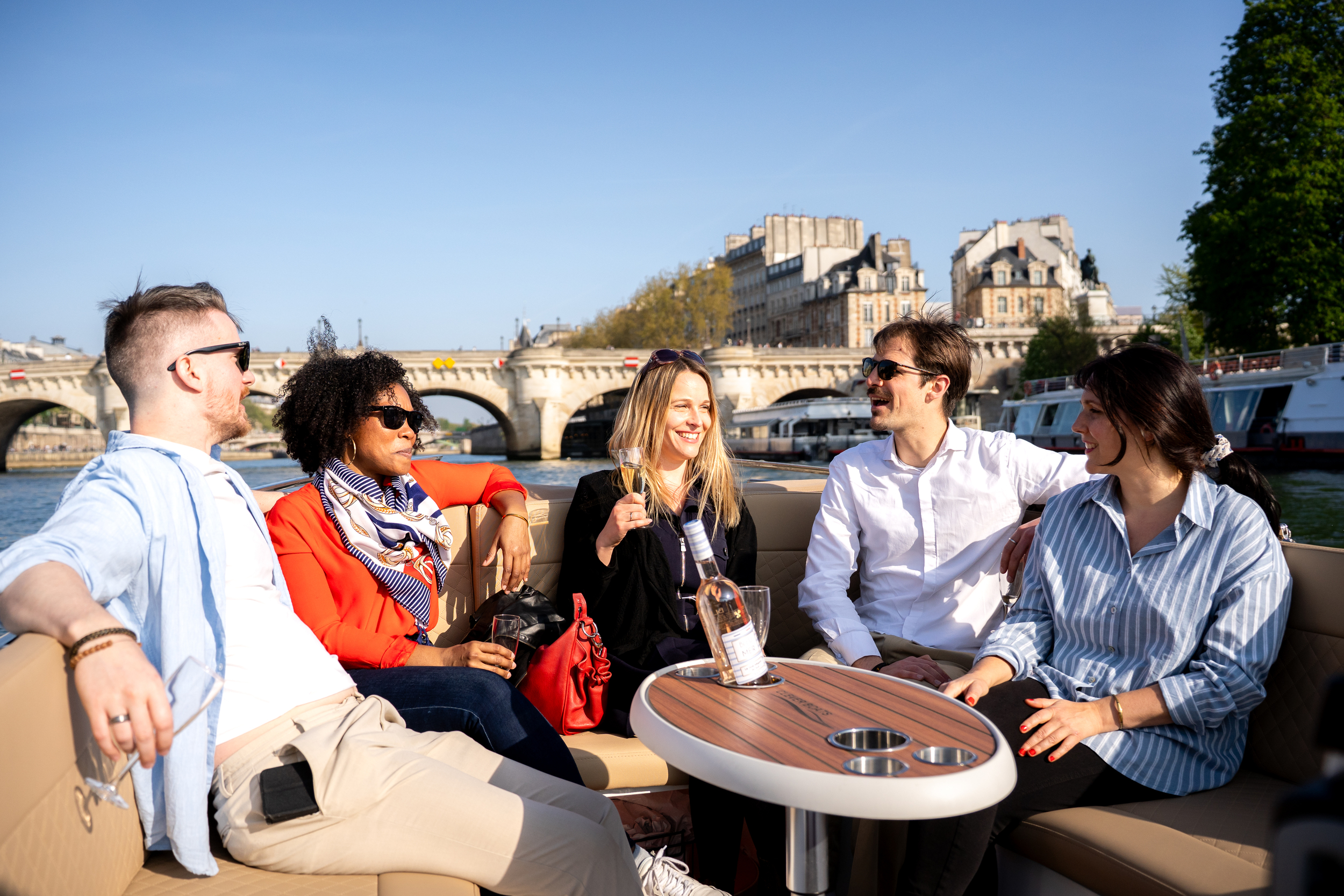
To genuinely appreciate the sweeping skyline, chartering a private vessel completely alters the entire dynamic of the afternoon. On a dedicated, private boat, passengers actively enjoy the absolute freedom to move about the open deck, guaranteeing optimal viewing angles for every passing monument. The prevailing quiet environment allows seated individuals to distinctly notice the subtle acoustic changes as the boat glides directly beneath wide stone arches. Crucially, there are absolutely no strangers on board, meaning the entirety of the floating space belongs exclusively to you and your personally chosen companions. This extremely high level of exclusivity seamlessly transforms a standard sightseeing activity into a sophisticated, highly memorable architectural study. Whether a guest is observing the soft early morning sunlight warming the limestone facades or watching the sprawling city illuminate with electric lights as dusk finally falls, the absolute privacy of a dedicated boat ensures an entirely uninterrupted, deeply personal voyage.
In exploring the unique perspectives of the city, one can gain a deeper understanding of its architectural beauty by reading a related article that delves into the various ways to experience Paris from the water. This piece highlights the charm of the Seine River and its significance in shaping the city’s landscape. For more insights, you can check out the article here, which offers a fascinating look at how boat tours can enhance your appreciation of Parisian architecture.
Why “Boat in Paris” Offers the Premier Architectural Tour
| Landmark | Description | Architectural Style |
|---|---|---|
| Eiffel Tower | An iconic iron lattice tower located on the Champ de Mars in Paris. | Structural Expressionism |
| Notre-Dame Cathedral | A medieval Catholic cathedral on the Île de la Cité in the fourth arrondissement of Paris. | Gothic |
| Louvre Museum | One of the world’s largest museums and a historic monument in Paris. | Neoclassical, Renaissance |
| Palais Garnier | A 1,979-seat opera house, which was built from 1861 to 1875 for the Paris Opera. | Neo-Baroque |
For those actively seeking the absolute highest quality maritime experience currently available in the capital, Boat in Paris reliably provides a premier service tailored entirely around optimal comfort, total privacy, and deep, meaningful engagement with the historic surroundings.
A Personalized Route with Expert Narration
A comprehensive ninety-minute itinerary executed by Boat in Paris deliberately encompasses all the major structural landmarks lining the central waterfront. Crucially, the professional pilot steering the vessel additionally acts as a remarkably knowledgeable, localized guide. Instead of relying passively on a generic, memorized script, the pilot actively shares highly engaging stories, rich historical context, and fascinating, lesser-known anecdotes regarding the specific buildings passing exactly at that moment. If a particular passenger readily expresses a keen interest in the deep Gothic details of Notre-Dame, the industrial manufacturing history of the Eiffel Tower, or the complex engineering of the various bridges, the captain smoothly adapts the ongoing commentary to perfectly match those specific preferences. This warmly interactive conversational element decisively ensures that valued guests do not merely look blankly at the buildings; they fully understand the compelling human stories, political dramas, and complex engineering challenges existing firmly behind them.
Amenities That Enhance the Observation Experience
The carefully curated environment on a Boat in Paris cruise remains deliberately refined and highly welcoming. The boutique company specifically caters to discerning couples, relaxed families, and small, cohesive groups consisting of up to twelve guests. To perfectly complement the visual feast presented by the passing Parisian skyline, the attentive crew generously provides complimentary chilled rosé wine alongside traditional, locally sourced macarons. Enjoying a crisp glass of premium wine while comfortably seated on plush cushions alongside close family or lifelong friends significantly elevates the overall tone of the afternoon. The gentle, rhythmic rocking of the vessel on the current, combined seamlessly with high-end refreshments and a fully private, highly controlled setting, consistently leads guests to describe this exact cruise as the indisputable highlight of their entire visit to the city. Furthermore, the sheer convenience of utilizing a private departure point located merely a straightforward fifteen-minute walk from the base of the Eiffel Tower firmly ensures that adding this premium excursion into a busy daily itinerary requires extremely minimal logistical effort.